
It's time to upgrade your browser

Your current browser is no longer supported on llbean.com. Please upgrade to one of the following for a smoother, safer shopping experience with us:

Round Dining Tables

Find round dining tables that bring a classic shape to your dining space. As you compare options, consider tabletop dimensions, how many chairs you want to fit and the space needed to pull them out comfortably—helpful details for choosing the right table for your home.
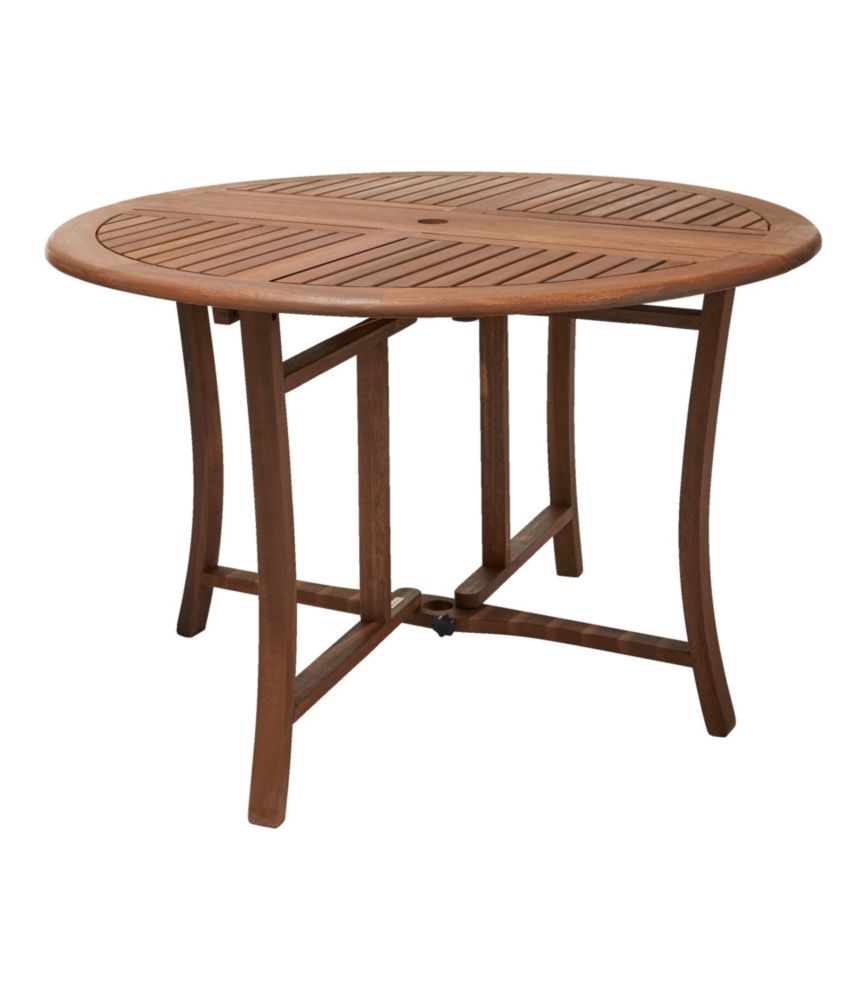
Eucalyptus Folding Table, Round
Outdoor Interiors Eucalyptus Folding Table, Round
A tan folding table crafted from weather-resistant eucalyptus hardwood with stainless steel hardware and umbrella hole.
(0)
$480 $480
SALE
$480 $480
SALE
All-Weather Counter-Height Table, 36" Round
L.L.Bean All-Weather Counter-Height Table, 36" Round
A green all-weather counter-height patio table made from HDPE lumber with durable stainless-steel hardware.
(0)
$550 $550
SALE
$550 $550
SALE
All-Weather Dining Table, Round 48"
L.L.Bean All-Weather Dining Table, Round 48"
A gray outdoor dining table with durable HDPE lumber and stainless-steel hardware for year-round weather.
(0)
$800 $800
SALE
$800 $800
SALE
All-Weather Dining Table, Round 36"
L.L.Bean All-Weather Dining Table, Round 36"
A brown outdoor dining table made from HDPE lumber and stainless steel, built for year-round weather.
(0)
$500 $500
SALE
$500 $500
SALE

Round Dining Tables

A round dining table brings people together around a shared center, with no head or foot of the table. That simple shape gives a dining space a distinct character: the arrangement is centered on the meal and the people gathered around it, rather than on two long sides and opposite ends. For a household that enjoys sitting down together, the appeal can be as much about that arrangement as it is about the look of the room. Breakfast for two, a family supper and dinner with a few friends all give the circular outline a familiar setting. Plates follow the curve, serving dishes occupy the middle, and each place becomes part of the same circle. Round dining tables also introduce a different line into rooms defined by straight walls, rectangular windows and doorways. The contrast can be understated, especially when the table’s proportions feel in keeping with the space around it. A centered arrangement can give a dining area a clear focal point, while an off-center placement may make more sense when the room has an unusual layout. Neither approach needs to feel overly formal. The table can be the setting for an ordinary Tuesday dinner just as readily as a carefully planned meal with guests. What matters is the relationship between the table, the room and the number of people who usually sit down together. A circular top does not automatically mean a small table, and a round shape does not automatically mean a casual style. Scale and design have just as much influence on the overall impression. A smaller circle can create an intimate dining arrangement, while a larger one makes a more substantial visual statement. Across those differences, the defining detail remains the same: dining places arranged around one continuous curve, without a designated position at either end.

The right proportions become clearer when the tabletop is considered alongside the space needed for seating. Diameter is the measurement across a round tabletop through its center, but that number describes only the top itself. The full dining arrangement extends farther once people are seated and farther still when seats are pulled back. Two tables with a modest difference in diameter can therefore feel noticeably different in the same room. A few additional inches reach outward in every direction, not just toward one wall. In a dining area near a doorway or a frequently used passage, that relationship deserves particular attention. The room should be considered as it is used during a meal, rather than as it looks when every place is neatly tucked in. Existing seating matters, too. Its width, height and position relative to the table help determine the arrangement, and the shape and location of the table base are relevant to the space beneath the top. A stated seating capacity is a useful reference, but it does not describe every household’s place settings or seating dimensions. A meal with individual plates and glasses occupies the tabletop differently from one that includes several shared serving dishes in the center. The number of people at dinner is only part of the picture; the way the table is set matters as well. For someone replacing an existing table, familiar measurements offer a useful point of comparison. The current arrangement may reveal a need for more space between places, less tabletop in the room or a different relationship to the surrounding walls. For a first dining space, a measured outline on a floor plan can make the circle’s scale more tangible. These considerations keep the choice grounded in everyday dining rather than in a photograph alone. The aim is a table whose proportions make sense for the room and the meals that happen there most often, with occasional guests considered alongside the household’s usual routine.

Style gives round dining tables another layer of individuality. The outline may be shared, but the visual character of a table depends on more than its shape. The thickness of the top, the profile of the edge and the proportions of the base all contribute to its appearance. A slender-looking silhouette makes a different impression from one with more substantial proportions, even when the diameter is similar. Details below the tabletop deserve a look as well, since they are part of the view from across the room. In a dining space with several existing design elements, the table does not need to repeat every detail to feel at home. A shared sense of scale or a similar degree of simplicity may be enough to bring the arrangement together. Those comparing broader furniture styles can also explore Wood Tables as part of the same search. For the round table itself, a clear sense of personal preference is often more useful than trying to recreate an entire room setting. Some households favor a quiet, understated centerpiece; others want the table’s form to stand out. Both approaches leave room for the dining area to reflect the people who use it. Everyday upkeep belongs in the decision, too, with the care directions for the particular table providing the reference rather than assumptions based on appearance. Those details matter after the room is arranged and the first meal has been served. A dining table becomes part of a household through repeated, ordinary moments: setting out breakfast, passing a dish across the middle or lingering over dinner together. Its place in the home is not defined by a single occasion. Choosing with those familiar meals in mind gives equal weight to appearance, proportions and the way people gather. That balance is at the heart of a thoughtful dining space, whether the setting is simple and informal or arranged with a little more ceremony.

FAQs