It's time to upgrade your browser

Your current browser is no longer supported on llbean.com. Please upgrade to one of the following for a smoother, safer shopping experience with us:

Round Tables

Find round tables that suit your space and complement your other furniture. As you explore the selection, compare tabletop diameter, table height and base design to narrow down your choices, leaving enough room around the table to move comfortably.

All-Weather Dining Table, Round 48"
L.L.Bean All-Weather Dining Table, Round 48"
A gray outdoor table made from durable HDPE lumber with stainless-steel hardware for year-round use.
(0)
$800 $800
SALE
$800 $800
SALE
All-Weather Dining Table, Round 36"
L.L.Bean All-Weather Dining Table, Round 36"
A durable green round table made from recycled-content HDPE lumber with marine-grade stainless-steel hardware.
(0)
$500 $500
SALE
$500 $500
SALE
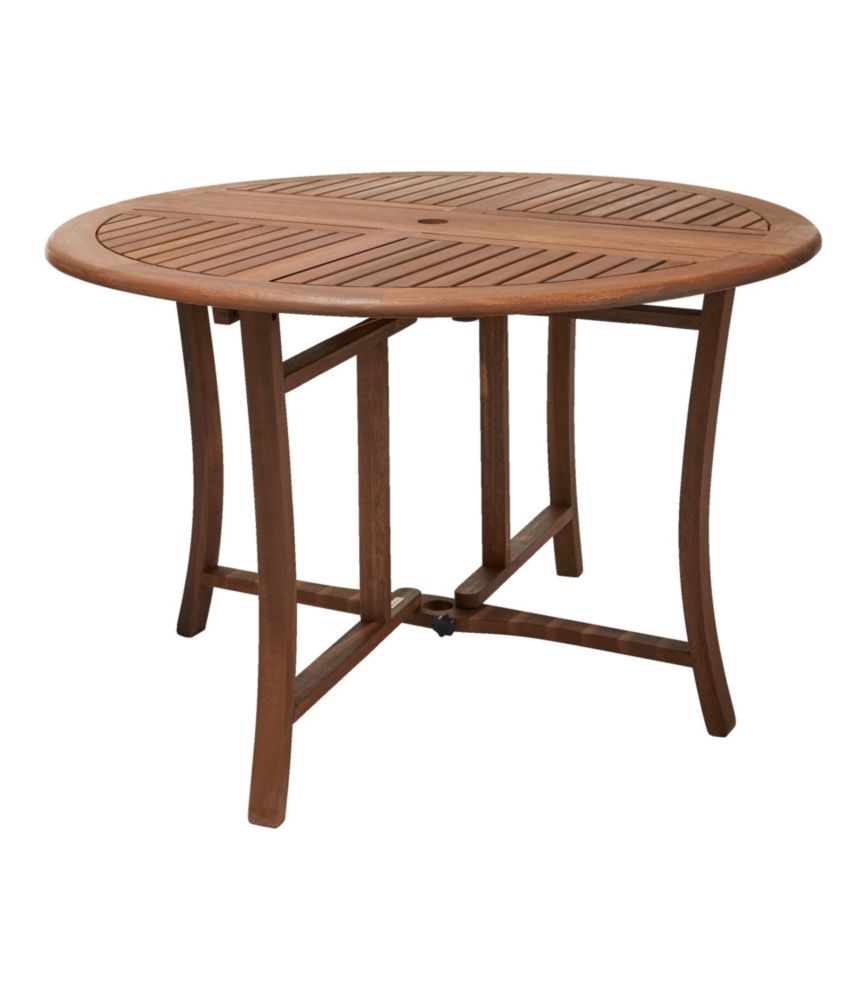
Eucalyptus Folding Table, Round
Outdoor Interiors Eucalyptus Folding Table, Round
A tan eucalyptus hardwood table with stainless steel hardware folds conveniently for weather-resistant outdoor dining.
(0)
$480 $480
SALE
$480 $480
SALE
All-Weather Counter-Height Table, 36" Round
L.L.Bean All-Weather Counter-Height Table, 36" Round
A green, weather-resistant outdoor table made from recycled-content HDPE lumber with stainless-steel hardware.
(0)
$550 $550
SALE
$550 $550
SALE
All-Weather Round Side Table
L.L.Bean All-Weather Round Side Table
A green, marine-grade table made from durable HDPE lumber with stainless-steel hardware for year-round use.
(397)
$130 $130
SALE
What customers like:
Easy to assemble
Good quality
Sturdy
Beautiful color
Well made
$130 $130
SALE
Eucalyptus Round Side Table
Outdoor Interiors Eucalyptus Round Side Table
A durable tan side table crafted from naturally weather-resistant Brazilian eucalyptus hardwood with stainless-steel hardware.
(27)
$180 $180
SALE
What customers like:
Easy to assemble
Matches other chairs
Beautiful outdoor side table
Good quality wood
Well made
$180 $180
SALE

Round Tables

Round tables offer a familiar furniture shape with a clear defining feature: a circular top. Unlike a rectangular or oval outline, a circle has no long side or short side, so its proportions stay the same whichever direction it is viewed from. That simple geometry gives the shape a distinctive place among furniture styles, from understated designs to more substantial silhouettes. The overall look depends on more than the top alone. The relationship between the tabletop, its edge and the base beneath it can make a design appear visually light or substantial, quiet or more prominent. When comparing round tables, consider those proportions alongside the furniture already in the space. A broad tabletop shown by itself in a photograph can look quite different once its dimensions are considered next to a nearby cabinet, chair or doorway. Diameter is the key measurement for understanding the top: it is the distance across the circle through its center. For scale, a 48-inch diameter measures 4 feet across, while a 60-inch diameter measures 5 feet across. These are measurement examples, not seating recommendations; a diameter alone does not establish how many chairs will fit around a table. Height is a separate consideration, as are the dimensions and position of the base. Keeping those details distinct makes comparisons more meaningful than relying on a photograph or a broad size description. It also helps separate two different preferences: the appearance of a generous circular top and the amount of space that top actually occupies. Both deserve attention, especially when the surrounding furniture has already been chosen.

The dimensions of the full arrangement matter just as much as the dimensions of the table. If chairs will accompany it, their width, depth and position belong in the comparison rather than being treated as an afterthought. A chair pushed beneath the edge occupies a different footprint from one pulled away from it, and a nearby wall or cabinet can affect the available clearance. A simple outline marked to the listed diameter can make scale easier to picture, particularly when an empty space makes every size seem possible. Consider the furniture in its normal arrangement, too: a cabinet with its door open, a chair pulled back, or a doorway with its usual path left clear. These details provide a more realistic picture than a measurement taken across an otherwise empty floor. Tabletop diameter and base dimensions should also be considered separately. The outer edge of the top does not reveal where supports sit underneath, so photographs from more than one angle and any listed measurements are useful points of comparison. When matching a table with existing chairs, compare the stated table height with the chairs’ seat and arm heights, and check any available information about clearance beneath the top. Overall height does not, by itself, describe that clearance. Likewise, a stated seating capacity should be read alongside the dimensions of the chairs being considered rather than treated as a universal fit. These are individual fit considerations, not reasons to assume that one diameter will work equally well in every arrangement. A few inches can change the relationship between separate pieces, even when each looks proportionate on its own. A thoughtful comparison accounts for the circle itself, the space around it and the furniture that will stand beside it, without expecting a single size label to answer every question.

Style is another useful way to compare round tables without losing sight of those practical details. Look at the outline first, then the smaller elements that give it character: the thickness of the top, the shape of its edge, the proportions of the base and the balance between the upper and lower sections. A rounded outline does not require every surrounding piece to repeat the same shape. It can sit within an arrangement of straight lines, or echo curved details already present elsewhere. Color can be considered separately from shape, which helps when the preferred silhouette is clear but the overall palette is still taking form. For a color-focused comparison, Black Tables offers another starting point. Existing furniture can provide a useful reference without making an exact match the goal; the aim is a considered relationship among pieces rather than identical details throughout. Close-up images and product descriptions are important here, since an overall photograph may not show the edge profile or other details clearly. The same attention belongs with care and upkeep. Follow the directions provided for the individual table rather than choosing a cleaning approach based on its color or appearance. Review any assembly information before making a decision, and keep the supplied instructions with other household reference materials afterward. Questions about construction, maintenance and recommended placement are best answered by the details provided for that particular table, not by assumptions about round furniture in general. Durability deserves the same product-by-product attention; shape alone is not a measure of how a table is made or maintained. Ultimately, the most useful comparison brings together clearly stated dimensions, a well-understood silhouette and care expectations that have been reviewed in advance. That keeps the choice grounded in the actual piece and its relationship to the space, while leaving room for the personal details that make a furniture arrangement feel like home.

FAQs