(SPEECH)
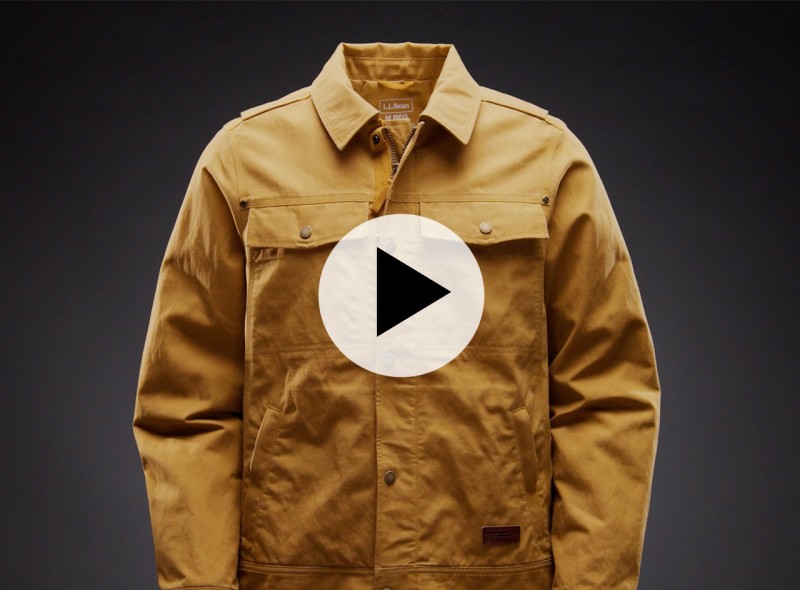
[00:00:00.04] You've probably seen this jacket everywhere, but we make the best. This is the original L.L.Bean Field Coat.
[00:00:06.18] [MUSIC PLAYING]
[00:00:09.35]
[00:00:09.80] Hi. I'm Meghan. I'm a Senior Designer at L.L.Bean, and we're here today to talk about our iconic field coat. So we're here in the workroom, and our product teams come together to discuss our new products, to discuss what's working well with our existing products, and to decide what happens in the line in the future. What inspires me most about working on outerwear that is the last layer between you and the outdoors, and it can really make or break your time outside.
[00:00:33.20] So the original field coat was designed in 1924, and we just celebrated our 100-year anniversary. Here I have a catalog from 1947. There is Bean's Field Coat, which is one of our earliest versions of the Field Coat. L.L. designed the original Field Coat for hunting and fishing and to withstand the briars and branches of the Maine woods. But today, people use it for so many other things.
[00:00:55.34] So let's talk about the details of the original Field Coat. We have a 10-ounce duck cotton, which is a super durable canvas. It already comes with a wash on it, so it's super comfortable the minute you get it. And then it also wears in really beautifully over time. It truly does get better the longer you wear it. It has reinforced shoulders, which ties back to the original heritage of the coat, where it was used for hunting.
[00:01:17.32] It also has these highly durable corozo buttons as well as a zippered pocket. The biggest feature of the Field Coat are these large, oversized, bellowed pockets, so plenty of room to store all your things, both in the top and in the bottom. There's grommets at the underarm. So if you're heated up a little bit, then you can let extra heat out. And then on the back side, here are these great action back details that gives you extra movement as you're wearing the coat.
[00:01:41.60] So let's look at the inside of the Field Coat. On this version, you can see we have a cotton lining. There's also a version with a removable wool lining. And it has corduroy trim at the collar and the cuff, as well. Inside the sleeves we have just a nice smooth taffeta lining, so super easy to get on over your layers.
[00:01:57.60] The Field Coat also has a nice, slightly oversized fit, so you can layer all the things you need to layer throughout the garment. There's this really heavy stitching and it is truly designed to last a very long time.
[00:02:09.65] L.L. didn't design the field coat to be fashionable, but it became an icon anyway. And it has some pretty big fans. To talk a bit more about the Field Coat's cultural impact. Let's talk to Brian.
[00:02:20.39] My name is Brian Davis, and I run Wooden Sleepers, a vintage men's clothing store in New York. Today, I'm here in Freeport, Maine, at L.L, the man's, house, which also doubles as L.L.Bean's archive.
[00:02:34.47] I think the Field Coat is an icon because it's instantly recognizable, and it has not changed much in the 100-plus years of its existence. These jackets are still around because they were well made. But the fact that it was well made and looked good and functioned for the purpose that it was designed for, I think that's why it's had such longevity over the years.
[00:02:59.61] I'm wearing a 1930s L.L.Bean Field Coat. It's not fussy. It's not pretentious. It's not a flex. It's just well made. I like to believe that this jacket could last another 100 years.
[00:03:12.63] For the person who walks into an L.L.Bean store today and buys a Field Coat, what a cool journey that you're about to embark on. How many memories are you going to create in that jacket? Each mark and scuff and patch and replaced button or whatever, those are all little badges of honor that make it truly yours.
[00:03:34.87] So on the product team, we get a lot of great customer stories. And I'm excited to share one of my favorite ones with you today. This Field Coat was sent back to the team several years ago with a note in the pocket explaining that they had bought a new field coat, and they wanted the team to look at the points where it had worn down so we could improve it.
[00:03:53.93] So this coat belonged to a gentleman named Richard who worked at NASA in research for a number of years. The customer says, I'm returning it not because it has performed unsatisfactorily. Indeed, it has served me well.
[00:04:07.66] So looking at a piece like this for inspiration is really helpful as the team and I work through the newer versions of our Field Coat. So you can see where it has been sun-faded from the way Richard had used the garment. He clearly spent a lot of time outside in this coat, using the pockets quite a bit as well. And I always really loved this piece and the story because our customers really care, and we really listen. So thank you, Richard. [LAUGHS]
[00:04:33.66] I feel a big responsibility to maintain the heritage and the details of the Field Coat. I almost see it as a design steward. Just preserving those details and just keeping those intact for the next several decades, I think, is really important. If you'd like to see more videos like this one, please hit the Like and Subscribe button down below.
[00:04:53.70] [MUSIC PLAYING]